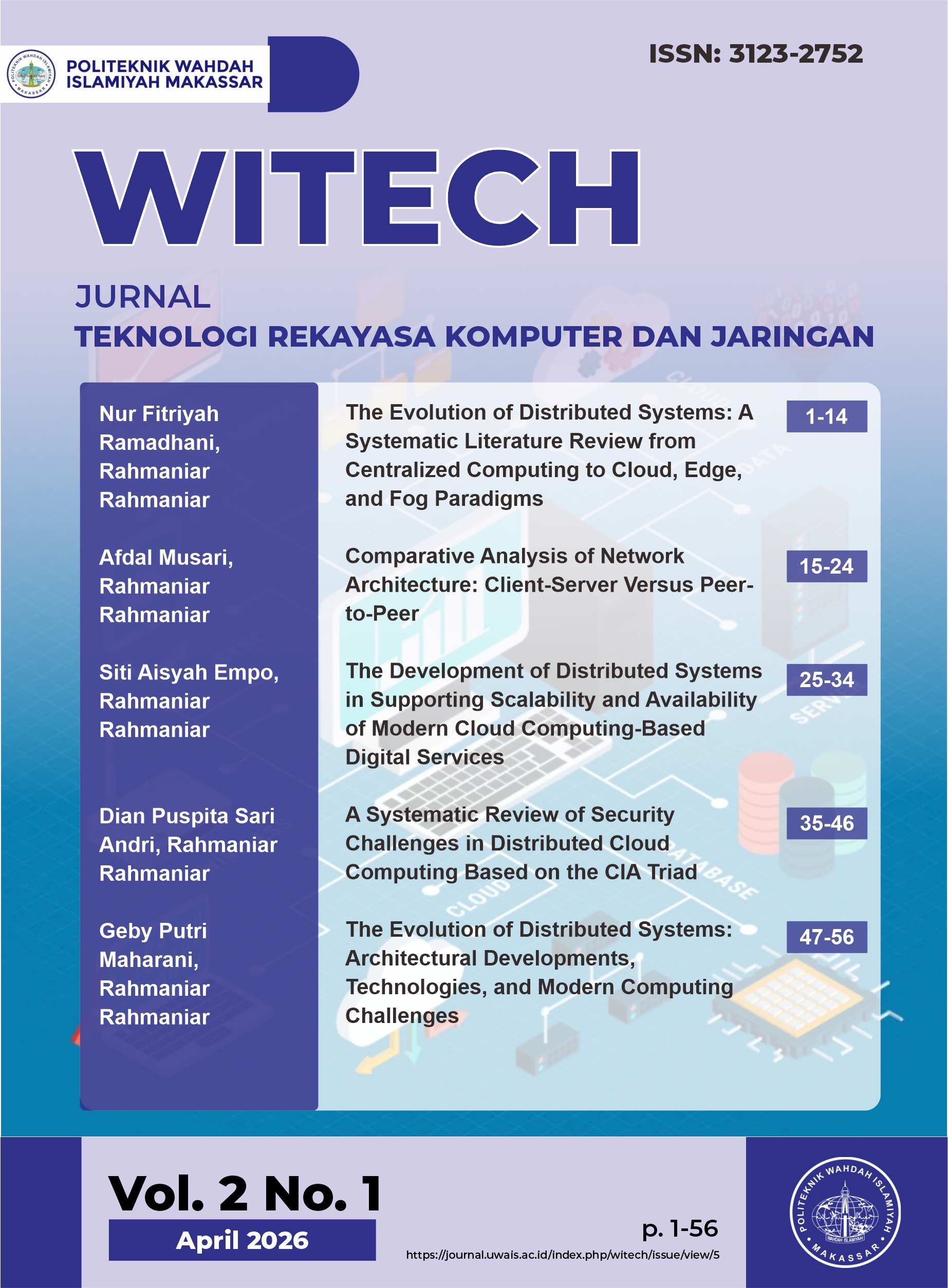
Comparative Analysis of Network Architecture: Client-Server Versus Peer-to-Peer
Analisis Perbandingan Arsitektur Jaringan: Client-Server Versus Peer-to-Peer
Keywords:
Comparative Analysis, Client-Server, Peer to PeerAbstract
Network architecture is the foundation of all modern digital communication, with the client-server and peer-to-peer (P2P) models being two dominant paradigms. This study aims to present an in-depth comparative analysis of these two architectures. Using a qualitative literature study method with sources from fundamental textbooks, international journals, and conference proceedings from the last ten years, this article examines the fundamental differences in topology, resource management, scalability, performance, and security. The main findings indicate that the client-server model excels in environments that demand centralized control, data consistency, and manageable security, making it ideal for business and financial applications. In contrast, the P2P architecture offers superior scalability, resilience, and cost-efficiency for large-scale decentralized applications such as file-sharing platforms and blockchain technology. The security analysis reveals that while P2P is vulnerable to specific attacks like Sybil and poisoning, the client-server model faces the risk of a single point of failure and a concentrated target for DDoS attacks. In conclusion, neither architecture is universally superior; the optimal choice is highly dependent on the specific goals, technical requirements, and threat model of the application being developed.
Downloads
Downloads
Published
Issue
Section
License
Copyright (c) 2026 Afdal Musari, Rahmaniar Rahmaniar (Author)

This work is licensed under a Creative Commons Attribution-NonCommercial-ShareAlike 4.0 International License.