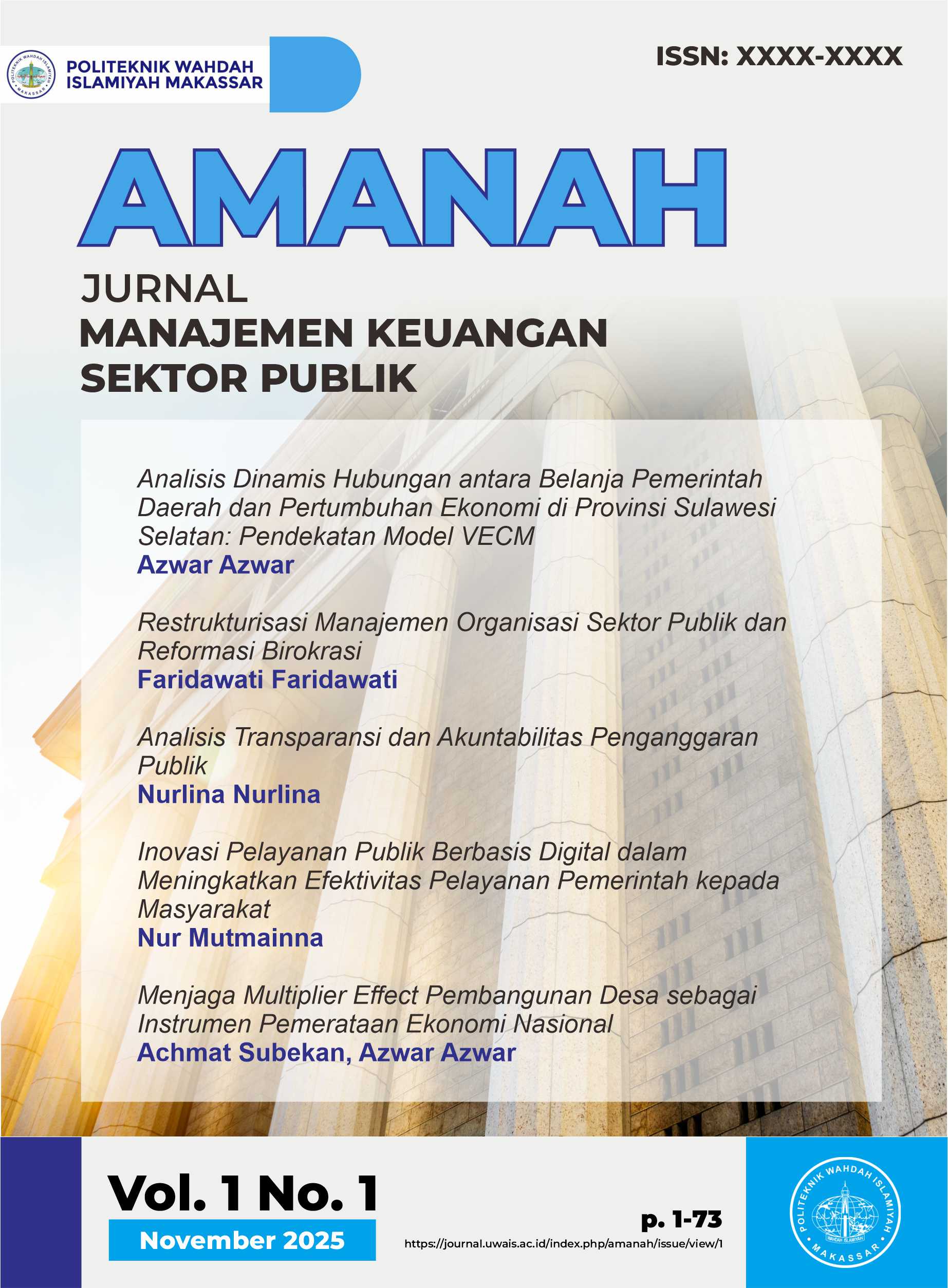
Analisis Dinamis Hubungan antara Belanja Pemerintah Daerah dan Pertumbuhan Ekonomi di Provinsi Sulawesi Selatan: Pendekatan Model VECM
Dynamic Analysis of the Relationship between Regional Government Expenditures and Economic Growth in South Sulawesi Province: VECM Model Approach
Keywords:
government expenditure, economic growth, VECM, Granger causality, South Sulawesi.Abstract
This study aims to analyze the long-term and short-term relationships between regional government expenditure and economic growth in South Sulawesi Province, as well as to identify the direction of causality and the dynamic interactions between the variables using an econometric approach based on time series data. Annual secondary data for the period 2010–2023 were obtained from the official publications of Statistics Indonesia (BPS) of South Sulawesi Province. The analysis employed the Vector Error Correction Model (VECM), including the Augmented Dickey-Fuller (ADF) stationarity test, optimal lag determination, and Johansen cointegration test. The Granger causality test was used to determine the direction of causal relationships, while the Impulse Response Function (IRF) and Variance Decomposition (VD) analyses were applied to assess the dynamic responses and relative contributions among variables. The results reveal a significant long-term relationship between government spending and economic growth with a negative direction, indicating the presence of a crowding-out effect. The significant and negative error correction term (ECT) suggests a relatively fast adjustment toward long-run equilibrium. However, in the short run, no significant causal relationship was found, implying that regional fiscal policy has not yet had a direct impact on economic growth. The IRF results show that shocks in government spending initially generate a short-term positive response in GDP, which subsequently weakens, while the VD results indicate that government spending contributes only modestly—around 2–7%—to variations in GDP. These findings underscore the need to enhance the effectiveness and productivity orientation of public spending to foster sustainable regional economic growth.
Downloads
References
Abimanyu, Y. (2016). Pengeluaran pemerintah dan impaknya terhadap pertumbuhan ekonomi di Indonesia. Badan Kebijakan Fiskal Kementrian Keuangan.
Ahmed, H., & Miller, S. M. (2000). Crowding‐out and crowding‐in effects of the components of government expenditure. Contemporary Economic Policy, 18(1), 124–133.
Dinarjito, A., & Dharmazi, A. (2020). Pengaruh Desentralisasi Fiskal, Investasi, Dan Indeks Pembangunan Manusia Terhadap Pertumbuhan Ekonomi Regional Di Provinsi Kalimantan Timur. Jurnal Pajak Dan Keuangan Negara (Pkn), 1(2), 57–72. https://doi.org/10.31092/jpkn.v1i2.789
Gujarati, D. N. (2012). Dasar-Dasar Ekoenometrika. Salemba Empat. https://onesearch.id/Author/Home?author=Damodar+N+Gujarati.
Haug, A. A. (1996). Tests for cointegration a Monte Carlo comparison. Journal of Econometrics, 71(1–2), 89–115.
Iskandar, A. (2021). Desentralisasi Dan Efisiensi Belanja Fungsi Pendidikan Serta Implikasinya Terhadap Kesejahteraan Masyarakat Di Propinsi Sulawesi Selatan. INFO ARTHA, 5(1), 11–24. https://doi.org/10.31092/jia.v5i2.1139
Jahan, S., Mahmud, A. S., & Papageorgiou, C. (2014). What is Keynesian economics. International Monetary Fund, 51(3), 53–54.
Lütkepohl, H. (2005). Vector error correction models. In New Introduction to Multiple Time Series Analysis (pp. 237–267). Springer.
Marliana, R., Prasetyo, A. S., & Yulianto, P. D. (2022). Pengaruh Pendapatan Asli Daerah (Pad), Dana Alokasi Umum (Dau), Dana Alokasi Khusus (Dak), Dana Bagi Hasil (Dbh) Dan Sisa Lebih Pembiayaan Anggaran (Silpa) Terhadap Belanja Modal Di Provinsi D.I. Yogyakarta Tahun 2013-2020. Jurnal Riset Akuntansi Dan Bisnis Indonesia, 2(2). https://doi.org/10.32477/jrabi.v2i2.489
Musgrave, R. A. (1989). The three branches revisited. Atlantic Economic Journal, 17(1), 1.
Nurani, I., & Saleh, M. S. S. S. (2023). Peran Belanja Modal Sebagai Efek Mediasi Pada Kinerja Keuangan Daerah Terhadap Pertumbuhan Ekonomi Kabupaten Dan Kota Di Provinsi Kalimantan Barat. Jurnal Dimensi, 12(1), 346–363. https://doi.org/10.33373/dms.v12i1.5683
Prawiroyudo, M. P., & Suhendro, S. (2023). Pengaruh Pertumbuhan Ekonomi, Pendapatan Asli Daerah, Dana Alokasi Umum Dan Dana Alokasi Khusus Terhadap Pengalokasian Anggaran Belanja Modal (Studi Empiris Pada Pemerintah Kabupaten Dan Kota Se-Indonesia Tahun 2018- 2021). Management Studies and Entrepreneurship Journal (Msej), 4(6), 9934–9946. https://doi.org/10.37385/msej.v4i6.3935
Pusporini, I. D. (2020). Analisis Pengaruh Anggaran Pendapatan Dan Belanja Daerah Terhadap Pertumbuhan Ekonomi Di Provinsi Jawa Tengah. E-Jurnal Ekonomi Dan Bisnis Universitas Udayana, 485. https://doi.org/10.24843/eeb.2020.v09.i06.p01
Ramadhanti, A. T., Muchtar, M., & Sihombing, P. R. (2024). Realisasi APBD Sebagai Stimulus Pertumbuhan Ekonomi Provinsi Kalimantan Selatan. Journal of Law Administration and Social Science, 4(4), 566–575. https://doi.org/10.54957/jolas.v4i4.710
Rohyana, C., & Rozak, R. A. (2022). Pengaruh Pertumbuhan Pendapatan Asli Daerah Dan Pertumbuhan Belanja Modal Terhadap Kineja Keuangan Pemerintah Kabupaten Bandung. Land Journal, 3(2). https://doi.org/10.47491/landjournal.v3i2.2308
Safitri, M. I. D., Ananda, C. F., & Prasetyia, F. (2021). Analisis dampak belanja pemerintah daerah terhadap pertumbuhan ekonomi inklusif Jawa Timur. Indonesian Treasury Review: Jurnal Perbendaharaan, Keuangan Negara Dan Kebijakan Publik, 6(2), 85–96.
Simbolon, Y. C., Maksum, A., & Abubakar, E. (2020). Pengaruh PAD, SILPA, DAU, DAK Dan DBH Terhadap Alokasi Belanja Modal: Studi Kasus Pada Pemerintah Kabupaten/Kota Provinsi Sumatera Utara, Bangka Belitung, Kepulauan Riau Dan Bengkulu Periode 2012-2018. Jurnal Sains Sosio Humaniora, 4(2), 826–839. https://doi.org/10.22437/jssh.v4i2.11546
Sugiyono. (2022). Metode penelitian kuantitatif (ke-3). Alfabeta.
Tajuddin, I., & Kessi, A. M. F. (2024). Analisis Dampak Pertumbuhan Ekonomi Dan Belanja Daerah Di Kota Makassar Terhadap Pendapatan Asli Daerah. Jesya (Jurnal Ekonomi & Ekonomi Syariah), 7(1), 575–587. https://doi.org/10.36778/jesya.v7i1.1385
Tama, A. I., & Pujihastuti, I. (2022). Determinan Kemandirian Keuangan Pada Pemda Tingkat II Di Provinsi Jawa Tengah. Equity, 24(2), 261–276. https://doi.org/10.34209/equ.v24i2.3657
Vasile, V., Ştefan, D., COMES, C.-A., Bunduchi, E., & Ştefan, A.-B. (2020). Granger causality. Romanian Journal of Economic Forecasting, 23(4), 131.
Wahyudi. (2020). Pengeluaran Pemerintah dan Implikasinya Terhadap Pertumbuhan Ekonomi dan Tingkat Kemiskinan di Indonesia (pp. 103–113).
Widodo, S. (2020). Pengaruh Belanja Pemerintah Pusat (Belanja Modal, Belanja Barang, Dan Belanja Bantuan Sosial) Terhadap Pertumbuhan Ekonomi (Pdrb) Pemerintah Provinsi Tahun 2014-2019. J. Budg., 5(2), 1–17. https://doi.org/10.22212/jbudget.v5i2.87
Wulandari, S. O., Thoyib, M., & Mubarok, M. H. (2022). Faktor – Faktor Yang Mempengaruhi Kinerja Keuangan Pemerintah Daerah Pada Kabupaten/Kota Di Provinsi Sumatera Selatan. Jurnal Syntax Transformation, 3(08), 1134–1143. https://doi.org/10.46799/jst.v3i8.593
Zulvan, M. F., & Purbasari, H. (2024). Pengaruh Investasi, Belanja Modal, Dan Pendapatan Asli Daerah Pemerintah Daerah Terhadap Pertumbuhan Ekonomi. Jurnal Emt Kita, 8(1), 175–186. https://doi.org/10.35870/emt.v8i1.2095
Downloads
Published
Issue
Section
License
Copyright (c) 2025 Azwar Azwar (Author)

This work is licensed under a Creative Commons Attribution-NonCommercial-ShareAlike 4.0 International License.