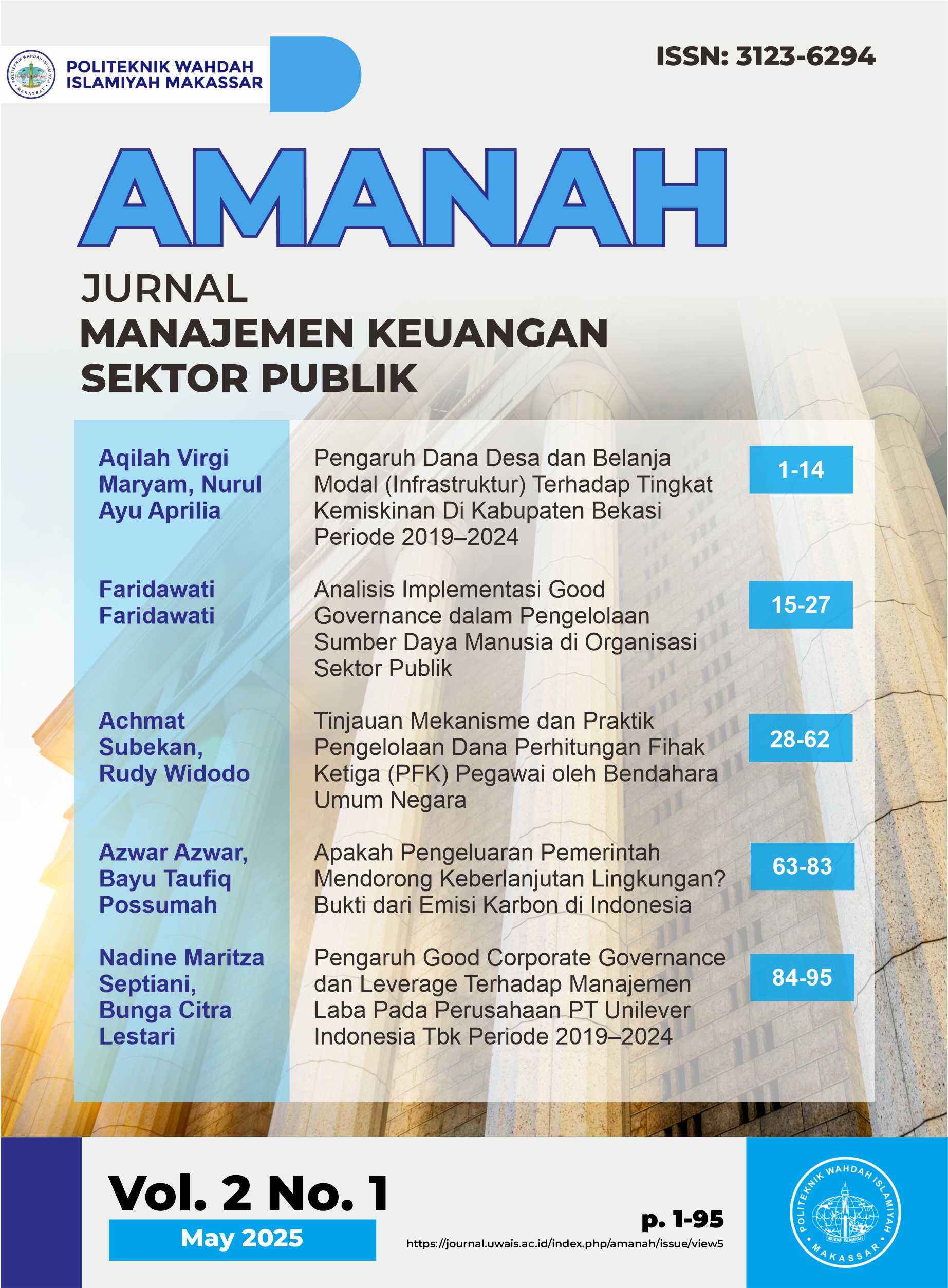
Apakah Pengeluaran Pemerintah Mendorong Keberlanjutan Lingkungan? Bukti dari Emisi Karbon di Indonesia
Does Government Expenditure Promote Environmental Sustainability? Evidence from Carbon Emissions in Indonesia
Keywords:
State General Treasurer, Employee Third-Party Funds (PFK), state treasury, financial governance, accountabilityAbstract
This study aims to examine the effect of government expenditure on carbon emissions in Indonesia using a quantitative econometric approach. Specifically, it aims to identify the direction and significance of the relationship between public spending and environmental outcomes, thereby providing empirical insights for aligning fiscal policy with sustainable development objectives. The study employs a multiple linear regression model based on annual time-series data covering the period 2000–2024. The data are obtained from the World Bank’s World Development Indicators (WDI), particularly the reporting period for national accounts data. The empirical results indicate that government expenditure has a negative and statistically significant effect on carbon emissions, suggesting that higher public spending may contribute to environmental improvement when allocated toward environmentally supportive sectors such as green infrastructure and efficient public services. Urbanization, however, shows a positive and significant relationship with carbon emissions, implying that urban growth in Indonesia remains associated with energy-intensive economic activities. Meanwhile, GDP does not exhibit a statistically significant effect, which may indicate a potential decoupling between economic growth and environmental degradation, although the evidence remains inconclusive. Energy use intensity shows a negative but statistically insignificant effect on carbon emissions. The findings suggest that fiscal policy can serve as a strategic instrument to support environmental sustainability when integrated with green economic policies and energy transition strategies.
Downloads
References
Aziz, S. K., Romadhon, A., & Handoyo, E. (2024). Impact of Economic Growth and Government Spending Policies on Co2 Emissions in South Sulawesi: Regression Analysis and Ekc. Marginal Journal of Management Accounting General Finance and International Economic Issues, 3(4), 981–993. https://doi.org/10.55047/marginal.v3i4.1411
Basuki, A. T. (2025). Economic Development and Fiscal Policy in CO2 Emission Mitigation: A Dynamic Panel Study in Indonesia Before Covid 19. Neo Journal of Economy and Social Humanities, 4(1), 23–37. https://doi.org/10.56403/nejesh.v4i1.253
Bletsas, K., Oikonomou, G., Panagiotidis, M., & Spyromitros, E. (2022). Carbon Dioxide and Greenhouse Gas Emissions: The Role of Monetary Policy, Fiscal Policy, and Institutional Quality. Energies, 15(13), 4733. https://doi.org/10.3390/en15134733
Bucchianico, S. D., Serio, M. D., Fragetta, M., & Melina, G. (2025). Time-Varying Impacts of Government Spending on CO2 Emissions. Imf Working Paper, 2025(132), 1. https://doi.org/10.5089/9798229013772.001
Ceylan, F. B. T. (2025). How Can Fiscal Policy Be Designed to Mitigate Climate Change, Reduce Income Inequality, and Promote Economic Growth? 123–148. https://doi.org/10.4018/979-8-3373-7360-7.ch005
Ding, X., Ma, G., & Cao, J. (2024). The Emission-Reduction Effect of Green Demand Preference in Carbon Market and Macro-Environmental Policy: A DSGE Approach. Sustainability, 16(16), 6741. https://doi.org/10.3390/su16166741
Fuglie, K. O., Ray, S., Baldos, U. L. C., & Hertel, T. W. (2022). The R&D Cost of Climate Mitigation in Agriculture. Applied Economic Perspectives and Policy, 44(4), 1955–1974. https://doi.org/10.1002/aepp.13245
Ghozali, I. (2006). Aplikasi analisis multivariate dengan program SPSS. Badan Penerbit Universitas Diponegoro. https://www.researchgate.net/publication/289671928_Aplikasi_Analisis_Multivariate_Dengan_Program_IBM_SPSS_21_Update_PLS_Regresi.
Iskandar, A. (2019). Economic growth and CO2 emissions in Indonesia: Investigating the environmental Kuznets curve hypothesis existence. Jurnal BPPK: Badan Pendidikan Dan Pelatihan Keuangan, 12(1), 42–52.
Jin, H., Yang, J., & Chen, Y. (2022). Energy Saving and Emission Reduction Fiscal Policy and Corporate Green Technology Innovation. Frontiers in Psychology, 13. https://doi.org/10.3389/fpsyg.2022.1056038
Johari, A., & Azwardi, A. (2025). CO2 EMISSIONS and MACROECONOMICS INDICATORS in EMERGING MARKET COUNTRIES. Journal of Economic Development Environment and People, 14(1), 75–94. https://doi.org/10.26458/jedep.v14i1.872
Jones, B. F., & Keen, M. (2011). Climate Policy in Crisis and Recovery. Journal of International Commerce Economics and Policy, 02(01), 103–119. https://doi.org/10.1142/s1793993311000245
Lau, L.-S., Choong, C.-K., & Kee, Y. (2014). Investigation of the environmental Kuznets curve for carbon emissions in Malaysia: DO foreign direct investment and trade matter? Energy Policy, 68, 490–497. https://doi.org/10.1016/j.enpol.2014.01.002
Le, N. M. T. (2026). Government Spending, Renewable Energy and Green Growth: Evidence From Vietnam. International Journal of Energy Economics and Policy, 16(2), 355–362. https://doi.org/10.32479/ijeep.22511
Li, F., Wu, Y., Wang, M.-C., Wong, W., & Xing, Z. (2021). Empirical Study on CO2 Emissions, Financial Development and Economic Growth of the BRICS Countries. Energies, 14(21), 7341. https://doi.org/10.3390/en14217341
Mtibaa, A. (2025). Assessing the Environmental Impact of Fiscal Consolidation in OECD Countries: Evidence From the Panel QARDL Approach. Journal of Risk and Financial Management, 18(9), 529. https://doi.org/10.3390/jrfm18090529
Pirgaip, B., Bayrakdar, S., & Kaya, M. V. (2023). The Role of Government Spending Within the Environmental Kuznets Curve Framework: Evidence From G7 Countries. Environmental Science and Pollution Research, 30(34), 81513–81530. https://doi.org/10.1007/s11356-023-25180-9
Pradana, H., & Fitriyanti, S. (2022). Causal Relationship Between Government Expenditure, Economic Growth, and Poverty in South Kalimantan. Jurnal Kebijakan Pembangunan, 17(2), 275–288. https://doi.org/10.47441/jkp.v17i2.280
Priyatno, D. (2023). Olah data sendiri analisis regresi linier dengan SPSS dan analisis regresi data panel dengan Eviews. Penerbit Andi.
Ridwan, M., Raihan, A., Ahmad, S., Karmakar, S., & Paul, P. (2023). Environmental Sustainability in France: The Role of Alternative and Nuclear Energy, Natural Resources, and Government Spending. Jeee, 2(2), 1–16. https://doi.org/10.56946/jeee.v2i2.343
Santoso, S. (2016). Panduan lengkap SPSS versi 23. Elex Media Komputindo. http://library.usd.ac.id/web/index.php?pilih=search&p=1&q=0000131168&go=Detail.
Suyanto, S., Almughni, M. A. A., Suprijati, J., Standsyah, R. E., & Dwiningwarni, S. S. (2024). Institutional Quality and Government Expenditure: An Empirical Study of the Environmental Kuznets Curve (EKC) in G20 Countries. EiS, 90(3), 883. https://doi.org/10.34659/eis.2024.90.3.883
Trofimova, E. A., Lapteva, E. V, & Muzafarov, N. R. (2022). The Impact of Government Environmental Protection Policy on CO2 Emissions. Market Economy Problems, (1), 169–184. https://doi.org/10.33051/2500-2325-2022-1-169-184
Xing, L., Li, J., & Yu, Z. (2022). Green Finance Strategies for the Zero-Carbon Mechanism: Public Spending as New Determinants of Sustainable Development. Frontiers in Environmental Science, 10. https://doi.org/10.3389/fenvs.2022.925678
Yan, J., & Wang, R. (2024). Green Fiscal and Tax Policies in China: An Environmental Dynamic Stochastic General Equilibrium Approach. Sustainability, 16(9), 3533. https://doi.org/10.3390/su16093533
Yang, Y., & Peng, C. (2024). Does the Green Finance Reform and Innovation Experimental Zone Policy Reduce Carbon Emission Intensity? Evidence From Chinese Cities. Frontiers in Energy Research, 11. https://doi.org/10.3389/fenrg.2023.1337594
Downloads
Published
Issue
Section
License
Copyright (c) 2026 Azwar Azwar, Bayu Taufiq Possumah (Author)

This work is licensed under a Creative Commons Attribution-NonCommercial-ShareAlike 4.0 International License.